
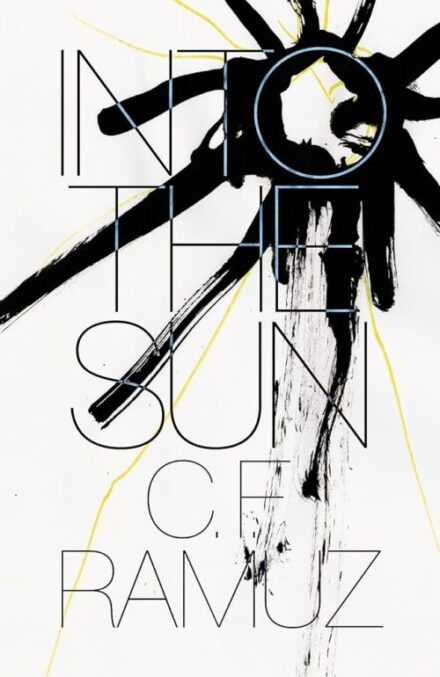
Into the Sun by C.F. Ramuz (Author), Olivia Baes, (Translator), Emma Ramadan (Translator)
“It’s been a hot summer for a Swiss lakeside town—both bucolic and citylike, old-fashioned and up-to-date—when a “great message,” telegraphed from one continent to another, announces an “accident in the gravitational system.” Something has gone wrong with the axis of the Earth that will send our planet plunging into the sun: it’s the end of the world, though one hardly notices it, yet … “Thus all life will come to an end. The heat will rise. It will be excruciating for all living things … And yet nothing is visible for the moment.”
For now the surface of the lake is as calm as can be, and the wine har vest promises to be sweet. Most flowers, however, have died. The stars grow bigger, and the sun turns from orange-red to red, and then to black-red. First comes denial: “The news is from America, you know what that means.” Then come first farewells: counting and naming beloved things—the rectangular meadows, the grapes on the vines, the lake. In its beauty the world is saying, “Look at me,” before it ends.”
“The prophetic Into the Sun vividly voices the initial disbelief, the rejection of the increasingly obvious facts, and the suppression of the gnawing doubts. Ramuz describes denial, fear, melancholy, despair, reckless abandon, and a swift slide into anarchy. Everyone seeks relief in the lake while the sun drinks it up “as if through a straw.” Ramuz’s terrifyingly gripping scenario of a burning planet and the demise of humankind—now so fatefully on our horizon—is a stirring blast from the past, a truly hair-raising tour de force.”
“Into the Sun―a radically strange and frighteningly prescient climate-disaster novel written a century ago by C. F. Ramuz, the great and eccentric Swiss-French novelist―is a book to boil youhardly notices it, yet … “Thus all life will come to an end. The heat will rise. It will be excruciating for all living things … And yet nothing is visible for the moment.”
Editorial Reviews
Review
“The greatest Swiss novelist of the French language.”
― Francois Bondy, The New York Times
“Through the telescope of time, it is easy to see how navigating both fluidity and fragmentation allowed Ramuz to join those twentieth-century novelists who redefined literature―Proust, Woolf, and Mann.”
― Patti M. Marxsen, Asymptote Journal
” Ramuz is the only contemporary writer who gives me the impression of having done something new.”
― Andre Gide
“In this vivid and prescient 1922 novel from Swiss author Ramuz (Great Fear on the Mountain), rapid climate change brings about societal breakdown. The crisp translation enhances the stark imagery and uncanny foresight. This is striking.”
― Publishers Weekly (starred review)
“The terror of Ramuz’s fiction has little to do with the fate of his individual characters―many of whom suffer merciless and usually abrupt deaths. The terror derives instead from the austere, godlike view of all human enterprise. In Ramuz, there is no eye on the sparrow. What seems at first to be a tale of nature’s revenge reveals itself to be something far bleaker: a portrait of nature’s indifference.”
― Nathaniel Rich, The New Yorker
“It’s impressive how true the book is to its premise and, in Ramuz’s hands, how real this fable appears.”
― Aaron Labaree, Chicago
“Ramuz is the only contemporary writer who gives me the impression of having done something new.
“A radically strange and frighteningly prescient climate-disaster novel—written a century ago by C. F. Ramuz, the great and eccentric Swiss-French novelist—is a book to boil you.”
About the Author
Charles Ferdinand Ramuz (1878–1947) is the preeminent francophone Swiss writer of the twentieth century. Often set in remote Swiss villages, his many novels―enigmatic, mystical, apocalyptic―fascinated Céline, Gide, and Giono. Céline predicted that Ramuz would be among a handful of his contemporaries who were going to be read in the year 2000. He also wrote the libretto for his friend Stravinsky’s The Soldier’s Tale.
Olivia Baes translated C.F. Ramuz’s 1908 novel Jean-Luc persécuté.
Emma Ramadan is the recipient of the PEN Translation Prize, the Albertine Prize, an NEA Fellowship, and a Fulbright. Her translations include Ahmed Bouanani’s Shutters for New Directions.